

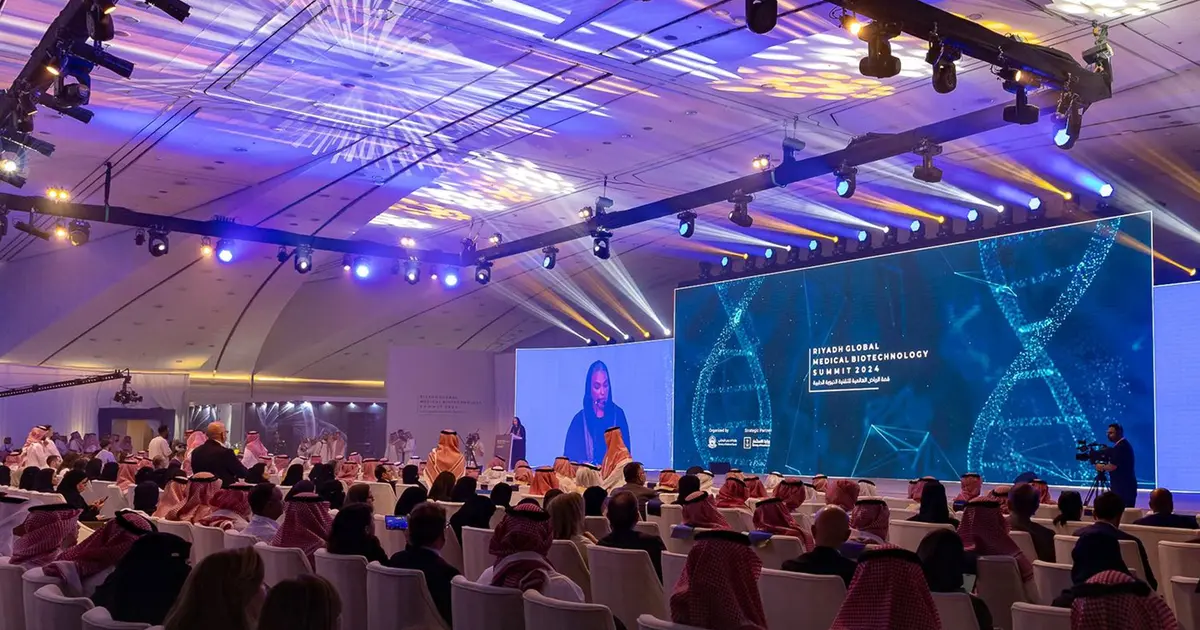
During the Riyadh Global Medical Biotechnology Summit 2026, held from 14 to 16 September and organized by the Health Affairs of the Ministry of National Guard in partnership with the Ministry of Investment, Dr. Batool Al-Baz, Vice President of King Abdulaziz City for Science and Technology (KACST) for the Health Sector, affirmed that the Kingdom is moving to transform its biotech ambitions into sustainable national capabilities, building on the National Biotechnology Strategy launched by Crown Prince Mohammed bin Salman, which supports Saudi Vision 2030 goals for human health and the national economy.
Al-Baz explained that the national strategy aims to make Saudi Arabia a leading biotech hub in the Middle East and North Africa by 2030 and a global center by 2040, contributing 130 billion riyals to GDP, nearly 3%, by 2040, and creating 11,000 jobs by 2030 rising to 55,000 by 2040. The strategy focuses on four priority areas: vaccines, biomanufacturing and localization, genomics, and plant agriculture improvement.
She noted that KACST's health sector, with 139 researchers since 2023, has completed 45 research projects, published 216 peer-reviewed papers, and secured 10 granted patents and 7 registered patents, alongside 7 strategic partnerships in genomics, precision medicine, vaccine development, biomanufacturing, stem cells and regenerative medicine, and molecular diagnostics. «KACST is one of the national pillars in biotechnology, building shared capabilities for the ecosystem and developing programs that turn research and development into tangible impact on human health and the national economy,» Al-Baz said.
On the sidelines of the summit, KACST launched 'Salem', an open-source tool to help verify interactions between drugs, foods, and herbs, and signed a strategic partnership with Cellbae for Research and Studies to localize, develop, and produce high-sensitivity lateral flow tests for rapid disease detection. These steps reinforce the summit's role as a platform for advancing Saudi Arabia's biotech sector and translating national strategy into concrete outcomes.