

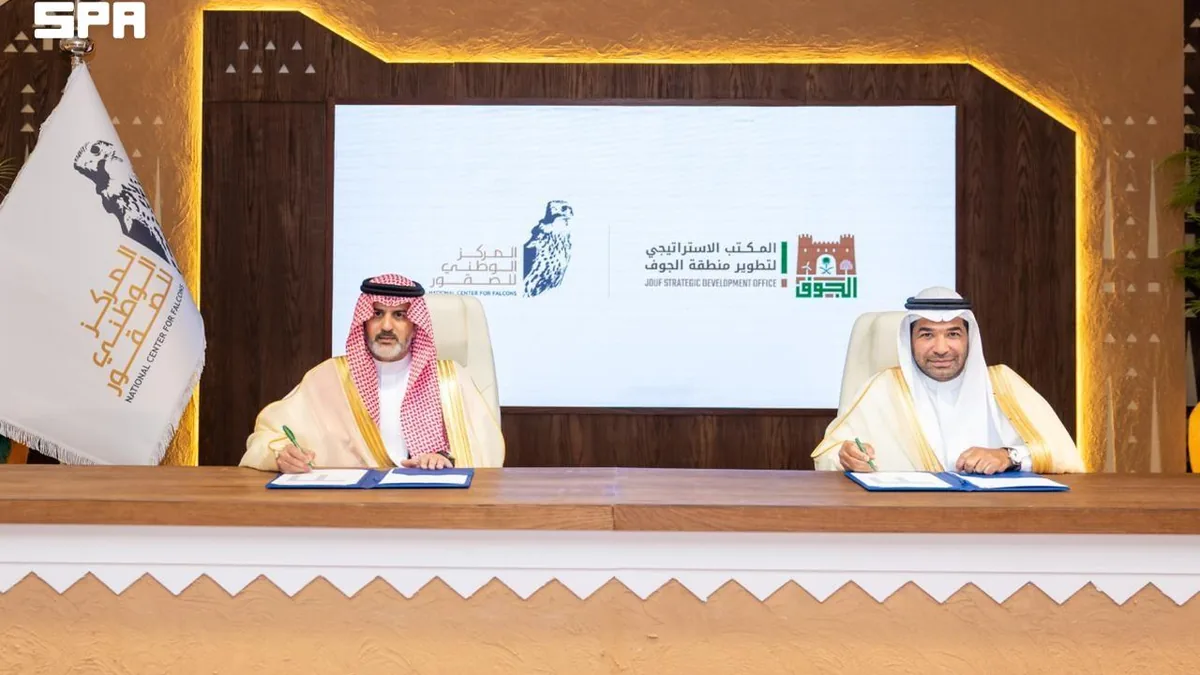
The National Center for Falcons and the Strategic Office for the Development of Al-Jouf Region signed a cooperation agreement on the sidelines of the International Saudi Falcons and Hunting Exhibition 2026, in a move that links falconry heritage preservation with development, tourism and environmental protection tracks.
The agreement was signed on behalf of the center by its Executive Vice President Ahmed bin Fahd Al-Hababi, and on behalf of the office by the Executive Vice President for Economic Development and Tourism, Engineer Hassan bin Mohammed Al-Zain Al-Din, according to the Saudi Press Agency.
The two sides will work on planning, studies and research related to falcons and falconry, developing priority initiatives and projects, exchanging data and knowledge, and building innovative solutions, alongside planning, organizing and developing events, festivals, exhibitions, competitions and auctions, in addition to developing tourism and cultural products and experiences that support the economic and tourism dimensions.
The scope extends to preserving, documenting and raising awareness of falconry heritage, running awareness and training programs, workshops, capacity building and community participation, as well as protecting falcons, their natural habitats and biological diversity, promoting sustainable hunting, and studying programs for releasing, resettling, tracking and monitoring falcons in coordination with the competent authorities.
The agreement also covers developing investment and commercial opportunities linked to falcons and falconry, supporting small and medium enterprises and entrepreneurs, attracting investors, sponsors and supporters, growing revenues for joint initiatives, and cooperating in media, marketing and institutional communication to highlight the programs and initiatives produced by the partnership. The signing falls within the National Center for Falcons' drive to expand its partnerships with relevant entities, connecting falconry heritage preservation with development, investment, tourism and environmental protection paths in a way that sustains it and widens its cultural and economic impact.